
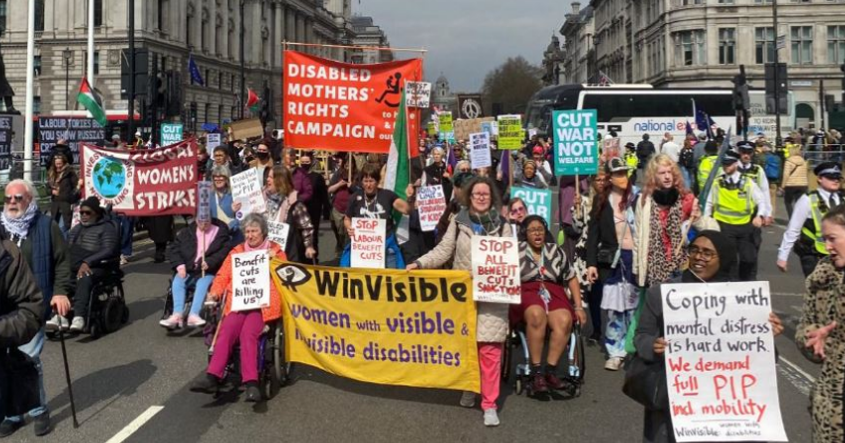
Here is our response sent to the Department for Work and Pensions (DWP) call for evidence on Carers Allowance. Jointly by the Wages for Housework Campaign/Global Women’s Strike and WinVisible (women with visible & invisible disabilities).
The DWP’s call for evidence on CA makes out that all that’s needed is to juggle unpaid care with more flexible paid work. This increases our overwork and exhaustion – how offensive! Mothers and other family carers are insultingly labelled “economically inactive” yet we save the government and councils at least £184 billion a year.
This statement recaps our key demands and tackles adult social care, independent living, inclusion of those of us who are asylum seekers and refugees, Carers Allowance and how care and support to live full lives, based on mutually respectful relationships, can be achieved, including with a Universal Care Income.
Download it here or read below — comments and feedback welcome!
* * *
Adult social care and Carers Allowance –
We want respectful caring and support, not neglect, impoverishment and private profits.
To the Burnham government, Casey Commission on adult social care (England), and DWP Carers Allowance call for evidence — by the Wages for Housework Campaign/Global Women’s Strike and WinVisible (women with visible & invisible disabilities)
Our right to care for ourselves and each other – our right to life – is legally recognised but is often not respected. It must be financially enabled. Women are the majority of disabled people/pensioners, at least 59% of unwaged family carers, and 79% of waged carers, often immigrant, mostly with profiteer companies for low pay. Most of us are mothers and grandmothers who have raised children and taken care of families. As Baroness Casey points out, society must acknowledge that a major reason for the “care crisis” is that most women are now working for wages while we used to work inside the home unwaged, caring for families. Our need for care and support has not gone away – but it is not just a job based on bodily functions, it is a relationship of mutual respect which can only thrive if it is socially prioritised by government spending.
- Most of us, older and younger alike, want to stay at home with loved ones, rather than be forced into care homes or sheltered housing. To achieve this, we need a high-quality flexible national independent living support service that enables us to live full lives, not a huge institution that merges social care with the NHS and makes decisions over our heads.
- Support and care services for all who need them. The number of older people receiving council services has plummeted by more than half. 79 older people die each day waiting for care. Of about 14 million older and younger disabled people in England, only 499,364 people with the highest needs receive council-funded care. 1m disabled pensioners fend for themselves without even family carers, including those of us who are LGBTQI+ or refugees, estranged or away from family support. Around 3.5 million of us lack services as councils turn us away or ration our hours. The government is attacking our right to PIP, but PIP pays for things like ready meals when there is no one to help us. Baroness Casey’s comments that disability may be too widely defined is also undermining our right to benefits.
- Free homecare. Councils charge us a homecare “contribution”, even if we don’t have any savings, and take it from our benefits – £153 a week is typical, down to the “Minimum Income Guarantee” amount we’re allowed to keep. This “minimum” is £116.80 a week for a disabled single mother – not enough to live on! Charges force us to cut down on food and heating, and to drop out of services, increasing isolation and domestic abuse. Charging is discretionary according to the law (Care Act 2014). Hammersmith & Fulham is the only council in England to have universal free homecare. In Wales, charges are capped at £100 a week. In Scotland, hands-on personal care is free but not other homecare people need. In the North of Ireland, Health and Social Care trusts don’t usually charge. Universal free homecare must be the rule, not the exception.
- Carers Allowance (CA) must become a living wage that financially recognises the social contribution of family carers so we are not impoverished when we exercise our right to care for loved ones. The DWP’s call for evidence on CA makes out that all that’s needed is to juggle unpaid care with more flexible paid work. This increases our overwork and exhaustion – how offensive! Mothers and other family carers are insultingly labelled “economically inactive” yet we save the government and councils at least £184 billion a year. CA importantly recognises caring work, but is a pittance at £86.45 a week for a minimum 35 hours of care. (In Ireland, CA is £230.54 to £263 a week, and even this is considered too low.) The conditions for UK CA are discriminatory. CA is cancelled out by retirement pension. Young people over 16 in full-time education can’t get CA. CA is tied to the disabled person’s disability benefit, so the whole household income collapses with DWP delays or problems, such as when teenagers move from DLA to PIP – a headache for mothers. You cannot earn more than £204 pw net AND qualify for CA. The outcry against the criminalisation of carers for going over this earnings limit even by 1p when we do some paid work to make ends meet, brought an inquiry but not an end to this cruelty. Means-tested Universal Credit standard allowance + carer element is hardly generous either, and is reduced as earnings increase.
- Universal Care Income (UCI) for everyone caring for people and planet, as in the UN Roadmap for Eradicating Poverty Beyond Growth (paras 202-205). This international Roadmap is wide-ranging and promotes a society for the wellbeing of people and planet. UCI recognises the vital caring work of mothers and other family carers, and self-care by disabled people alongside support services and disability benefits for our extra costs. UCI promotes choice for all and counteracts the conditions that spark abuse. In our submission, Global Women’s Strike said:
The Care Income aims to empower both the person who needs care and support, and the person who provides it. It does not aim to “free women from the burden of caring” so we can become “economically active”. Neither does it aim to stop women from pursuing other employment or to limit caring to women only. It promotes a caring relationship of dignity and respect for people of all genders while ending carers’ poverty and overwork.
Family caregivers in California are paid to support a loved one on Medi-Cal at home. In San Francisco, a Guaranteed Care Income pilot made mothers feel seen and valued, and provided the means to escape domestic violence and not have to turn to sex work to feed children. In Wales, a young single mother said about the basic income pilot for care leavers, “I was able to buy [my son] his formula, toys and new clothes without worrying.”
Social care must not be in the hands of private companies. (It is for “child protection”, profiting from pain of separation, and bankrupting councils.) Companies typically charge councils double per hour what they pay care workers, underpaying travel time and fuel costs. Ending Extraction in the UK Care System found £256m profit from adult and children’s care by companies in three regions in 2021-2024.
Disabled mothers, and all mothers, must have supportive services to keep our families together, not have our children taken away. We have a right to family life, not to be discriminated against. Support under Care Act s12 “needs of the family” and Children Act s17 must be statutory not discretionary. See our Disabled Mothers’ Rights Charter. Disabled women/mothers of disabled children must get both Universal Credit disability element (for extra costs of disability) AND carer element on top of coping with disability.
“No Recourse to Public Funds” must be abolished. It bars those of us who are immigrant or seeking asylum, from benefits, homeless assistance and non-emergency healthcare. Immigrant disabled people have to rely on the Care Act for housing, care and subsistence, as social care is not classed as public funds. But councils hate to spend on this so we can’t get our basic disability needs recognised unless we are legally represented. Shockingly, immigration rules deny mothers working in the NHS free healthcare.
How it’s funded – tax companies and the billionaires, and reclaim the military budget. Increase the government grant to councils. Lower earners can’t afford an extra social care tax for future needs, or private insurance which embeds a two-tier system. We already pay high Council Tax for local services. And at £62 billion pa before the war with Iran, the military budget is already double what is spent on adult social care. Invest in caring not killing – welfare not warfare!
August 2026
Contact us
gws@globalwomenstrike.net Website
Discover more from WinVisible
Subscribe to get the latest posts sent to your email.