
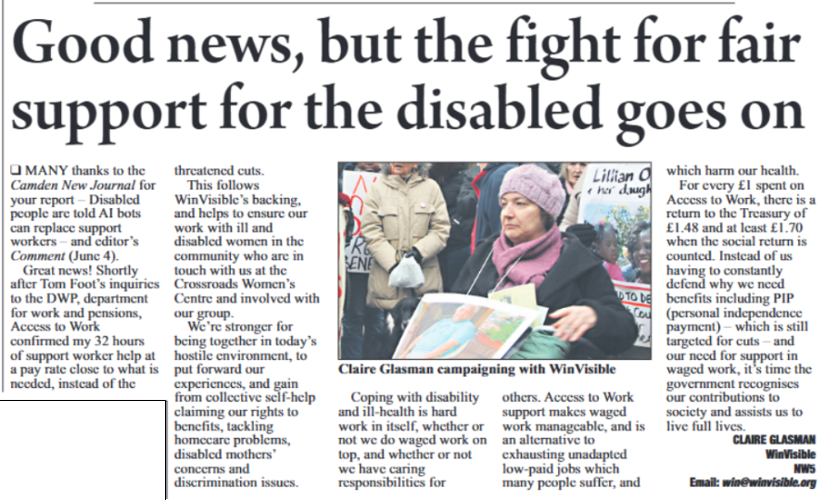
This coverage from the Camden New Journal marks a year-long struggle to get Access to Work support from the DWP, along with around 60,000 other disabled people. Our thanks also go to our friends at Touretteshero whose support and advice was invaluable.
Our letter, 9 July 2026
“Many thanks to the Camden New Journal for your feature “Disabled people are told AI bots can replace support workers” (4 June) and editor’s Comment.
Great news! Shortly after Tom Foot’s enquiries to the DWP, Access to Work confirmed my 32 hours of support worker help at a pay rate close to what is needed, instead of the threatened cuts. This follows WinVisible’s backing and helps to ensure our work with ill and disabled women in the community who are in touch with us at the Crossroads Women’s Centre and involved with our group. We’re stronger for being together in today’s hostile environment — to put forward our experiences, and gain from collective self-help claiming our rights to benefits, tackling homecare problems, disabled mothers’ concerns and discrimination issues.
Coping with disability and ill-health is hard work in itself, whether or not we do waged work on top, and whether or not we have caring responsibilities for others. Access to Work support makes waged work manageable, and is an alternative to exhausting unadapted low-paid jobs which many people suffer, and which harm our health. For every £1 spent on Access to Work, there is a return to the Treasury of £1.48 and at least £1.70 when the social return is counted. Instead of us having to constantly defend why we need benefits including PIP (Personal Independence Payment) — targeted for cuts – and need for adequate support in waged work, it’s time the government recognises our contributions to society and assists us to live full lives.”
Claire Glasman, WinVisible (women with visible and invisible disabilities)
Camden New Journal Comment 4 June 2026:
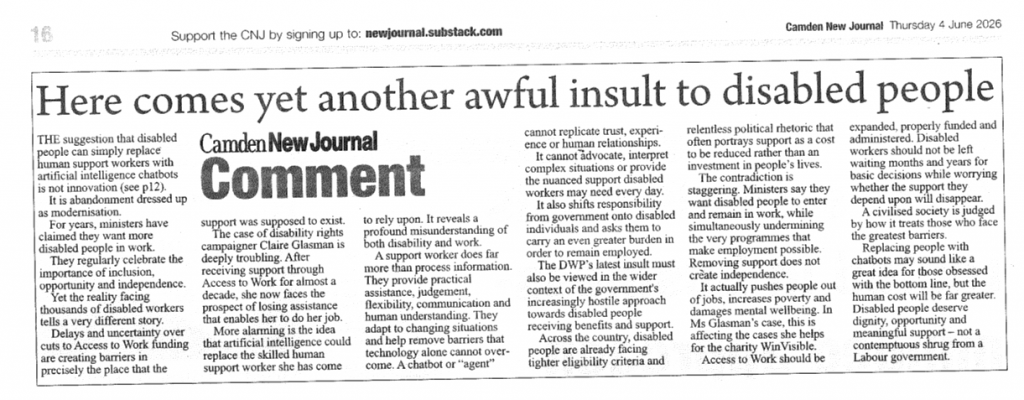
Here comes yet another awful insult to disabled people
“The suggestion that disabled people can simply replace human support workers with artificial intelligence chatbots is not innovation (see p12).
It is abandonment dressed up as modernisation.
For years, ministers have claimed they want more disabled people in work. They regularly celebrate the importance of inclusion, opportunity and independence. Yet the reality facing thousands of disabled workers tells a very different story. Delays and uncertainty over cuts to Access to Work funding are creating barriers in precisely the place that the support was supposed to exist.
The case of disability rights campaigner Claire Glasman is deeply troubling. After receiving support through Access to Work for almost a decade, she now faces the prospect of losing assistance that enables her to do her job.
More alarming is the idea that artificial intelligence could replace the skilled human support worker she has come to rely upon. It reveals a profound misunderstanding of both disability and work.
A support worker does far more than process information. They provide practical assistance, judgement, flexibility, communication and human understanding. They adapt to changing situations and help remove barriers that technology alone cannot overcome. A chatbot or “agent” cannot replicate trust, experience or human relationships.
It cannot advocate, interpret complex situations or provide nuanced support disabled workers may need every day.
It also shifts responsibility from government onto disabled individuals and asks them to carry an even greater burden in order to remain employed.
The DWP’s latest insult must also be viewed in the wider context of the governments increasingly hostile approach towards disabled people receiving benefits and support.
Across the country, disabled people are already facing tighter eligibility criteria and relentless political rhetoric that often portrays support as a cost to be reduced rather than an investment in people’s lives.
The contradiction is staggering. Ministers say they want disabled people to enter and remain in work, while simultaneously undermining the very programmes that make employment possible. Removing support does not create independence.
It actually pushes people out of jobs, increases poverty and damages mental wellbeing. In Glasman’s case, this is affecting the cases she helps for the charity WinVisible.
Access to Work should be expanded, properly funded and administered. Disabled workers should not be left waiting months and years for basic decisions while worrying whether the support they depend upon will disappear.
A civilised society is judged by how it treats those with the greatest barriers.
Replacing people with chatbots may sound like a great idea for those obsessed with the bottom line, but the human cost will be far greater. Disabled people deserve dignity, opportunity and meaningful support – not a contemptuous shrug from a Labour government.”
Original article in Camden New Journal
Disabled people are told AI bots can replace support workers
Campaigner says government is ‘sabotaging’ access to work scheme
Thursday, 4th June — By Tom Foot
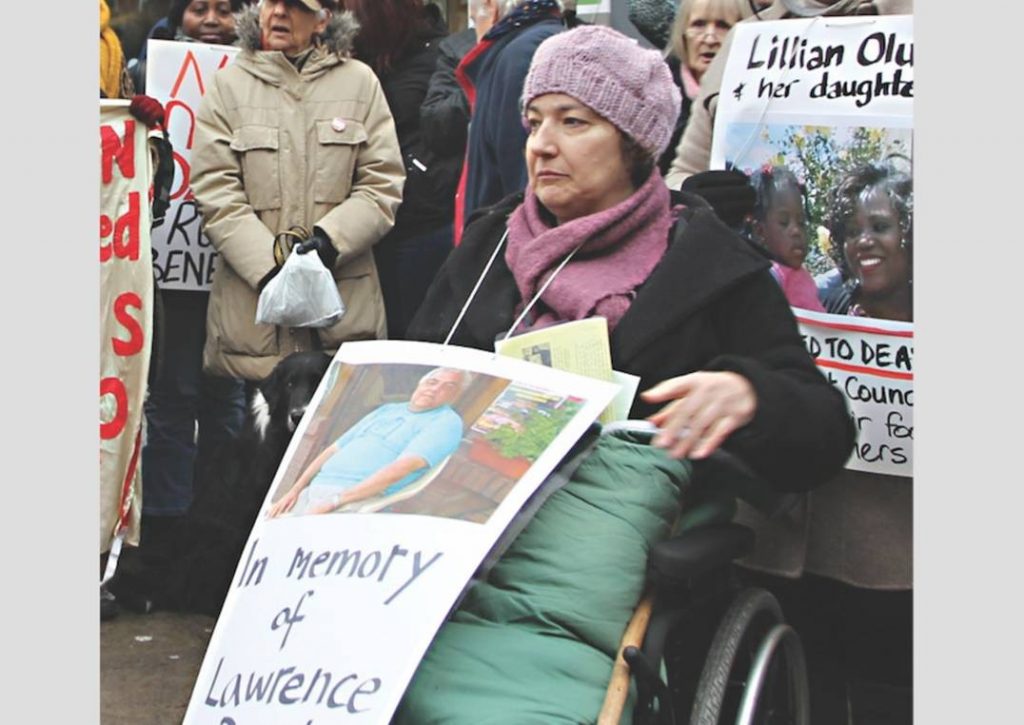
DISABLED people are being told they can replace support workers hired with an Access to Work grant with artificial intelligence chat bots.
Claire Glasman, who has spent decades fighting for disability rights, says her working life is being threatened by the “perverse logic” of the government’s “massive attack on our rights to benefits”.
She has been waiting for almost a year for a decision on whether the Department for Work and Pensions (DWP) will renew her Access to Work grant.
The grants are given out to disabled people to pay for support workers to help with complex and often exhausting admin that often undermine efforts to stay in work. But now tens of thousands of claimants are threatened with having the help stripped away – and the rise of AI is one of the justifications.
Ms Glasman, who has cerebral palsy and lives in Kilburn, said: “The government says disabled people should get into waged work and asserts that it is promoting job opportunities, but in reality it is sabotaging the Access to Work scheme.
“There have been long delays, with broken promises by the DWP to reply to emails by a certain date. This stress is compounded by worry over whether the level of support will be cut.
“If my support is cut, I won’t be able to do my job as required, and could be forced out of employment. Yet the government states that its policy is to encourage people with disabilities into work. It is also very unsettling for the support workers.”
The Public Accounts Committee (PAC) has launched an inquiry into the backlog crisis that is affecting tens of thousands of people across the country with a report due out later this year [Access to Work backlogs creating hardship and uncertainty for disabled people, PAC warns].
Ms Glasman said she does not feel AI could do the job of a human being and questioned whether the tech could be relied upon.
In her evidence to the PAC, said: “In the initial assessment call, we were told that AI can replace the existing support worker, despite this putting a burden on the disabled employee.”
Ms Glasman has had funding for a support worker 32 hours a week since 2016. Her last grant ended in August 2025. She said the support helps her find the mental space for her work at Winvisible, based in Kentish Town, which helps dozens of women with disabilities negotiate claims for grants and benefits each year.
A DWP spokesperson said: “We apologise to Ms Glasman for the delay and we are looking into this case. We are employing 500 additional staff to tackle the backlogs in the Access to Work scheme – which supports thousands of sick and disabled people.
“We inherited a backlog in this scheme and have been working with disabled people and their organisations to tackle it, as well as fast-tracking the claims of people who are about to start work.”
Discover more from WinVisible
Subscribe to get the latest posts sent to your email.